baeIoT Ecosystem
Blockchain × AI × Edge × IoT
The Internet of Things Made a Promise It Couldn't Keep
Billions of connected devices. Trillions in projected value. Smart everything.
And yet, your smart thermostat can't pay your electricity bill. Your agricultural sensor can't sell its data. Your autonomous drone can't negotiate airspace fees.
The Internet of Things gave devices connectivity. It never gave them agency.
Devices Want to Be Economic Participants
This isn't science fiction. It's the logical endpoint of three converging forces:
Blockchain gives devices economic identity — wallets, payments, contracts. A sensor can hold tokens and transact without a human approving each action.
AI gives devices cognitive capacity — local inference, federated learning, adaptive behavior. A device can decide, not just report.
Edge compute gives devices operational independence — processing at the source, offline capability, real-time response. A device can act, not just wait.
Combine them, and you get something new: devices that sense, decide, transact, and earn — autonomously.
We call this convergence baeIoT.
The Economy of Things
The Internet of Things was about data flow. Sensors push readings to clouds. Clouds push commands to actuators. Value accrues to platform owners.
The Economy of Things inverts this. Devices become first-class economic participants:
- A soil sensor earns by contributing to federated crop models
- A weather station sells hyperlocal forecasts to neighboring farms
- A delivery drone pays for priority routing in congested airspace
- A factory robot negotiates maintenance contracts based on its own wear data
This isn't devices serving an economy. This is devices participating in one.
The Trust Problem
Here's the catch: autonomous devices with wallets are terrifying.
A compromised sensor could drain its wallet to an attacker. A misbehaving drone could incur unlimited fees. An IoT botnet could become a money laundering network.
The industry's answer has been custody, let humans hold the keys, approve the transactions, bear the liability. But custody kills autonomy. If a human must approve every micropayment, you don't have autonomous devices. You have remote-controlled ones.
baeIoT proposes a different answer: bounded autonomy.
Devices hold their own keys. But spending is constrained by cryptographic policies, maximum per transaction, daily limits, approved payment types, enforced by zero-knowledge proofs. The device proves "this transaction satisfies my policy" without revealing the policy itself.
Not trust. Verification.
The Architecture
baeIoT isn't a product. It's a framework, a way of thinking about what devices could become.
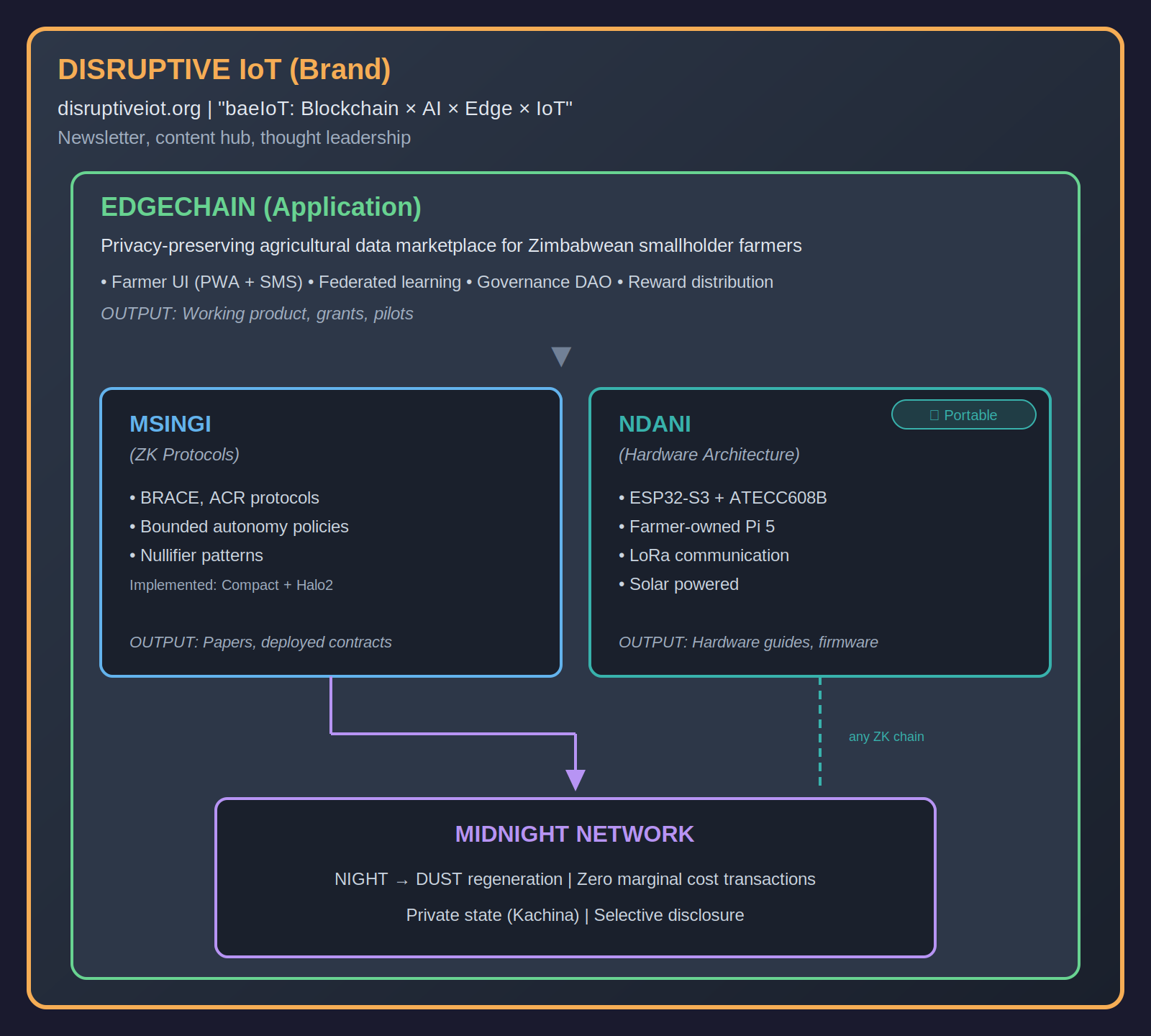
Our reference implementation has four layers:
DISRUPTIVE IoT     Brand & thesis — you're reading it
    ├── EdgeChain      Application — agricultural data marketplace
    │   ├── Msingi         Protocols — anonymous attestation, bounded spending
    │   └── Ndani          Hardware — farmer-owned proof infrastructure
    └── Dura           Knowledge — research portal & learning resources
EdgeChain is the proving ground: privacy-preserving agricultural intelligence for smallholder farmers in Zimbabwe (for now). Farmers contribute sensor data to collective AI models and earn rewards, without revealing who they are, where they farm, or what they grow.
Msingi (Swahili: "foundation") defines the protocols, how devices register anonymously, attest to data, and claim rewards. These protocols are portable. Today they run on Midnight. Tomorrow they could run on any ZK-capable chain.
Ndani (Swahili: "inside") is the hardware architecture, ~$160 of farmer-owned infrastructure that generates zero-knowledge proofs locally. No trusted intermediaries. No data leaving the farm.
Dura (Shona: "granary") is where we store and share knowledge. Just as farmers store harvest in a granary for the community, Dura houses research, tutorials, and technical deep-dives — making complex concepts accessible to builders exploring this space.
Why This Matters
The first wave of IoT created surveillance infrastructure. Devices that watch, record, and report, value flowing to whoever controls the cloud.
baeIoT imagines something different: devices that own their data, earn from their contributions, and operate within cryptographically-enforced boundaries.
Not IoT as extraction. IoT as participation.
Current Status
We're in the research and validation phase:
- Disruptive IoT blog live at disruptiveiot.org
- Dura science granary live
- EdgeChain demo live on Midnight testnet
- Msingi protocols specified, contracts deployed
- Ndani hardware validated, proof generation benchmarked
- Academic papers in preparation
This is a "basement project", built with conviction, not capital. We believe systems designed for the harshest conditions (2G networks, solar power, zero trust) can scale globally.
Follow the Journey
This blog explores the Economy of Things thesis, industry analysis, technical deep-dives, and the ideas driving this convergence.
EdgeChain Insights (LinkedIn) documents the build in public, the wins, the failures, the lessons from deploying privacy tech in rural Zimbabwe.
Dura is the science granary, tutorials on zero-knowledge proofs, federated learning explainers, and research resources for builders.
Devices don't just want to be connected. They want to be counted.