ARM's 2026 Predictions and the Economy of Things

The silicon giant is "catching up" to what we've been exploring in Zimbabwe.
ARM just released their 2026 tech predictions. For those unfamiliar, ARM doesn't make chips, they design the architecture that powers most of the world's IoT devices, smartphones, and increasingly, the edge AI hardware going into everything from factory robots to agricultural sensors.
When ARM makes predictions, they're not speculating. They're telling you where the silicon is going.
Disruptive IoT is a blog we use to communicate what we call the baeIoT framework (from bae of IoT: Blockchain × AI × Edge of IoT), infrastructure for devices that don't just sense, but transact, decide, and participate (Economy of Things). This framework guides our projects: EdgeChain (agricultural marketplace), Msingi (ZK protocols), Ndani (hardware architecture), and Dura (research). ARM is describing the hardware future. We're building the trust layer for it.
Three of their five predictions caught my attention. Not because they surprised me, but because they describe the future we've already been building.
Prediction #3: "Distributed AI drives real-time intelligence at the edge"
ARM's framing: "Rising edge AI capabilities will enable faster, smarter decisions directly on devices and systems, while reducing latency, cost, and cloud dependence."
This is the death knell for the centralized IoT model. The architecture where devices are dumb sensors shipping data to cloud servers for processing is being replaced by devices that think locally.
Why this matters for baeIoT:
The Ndani architecture, farmer-owned Raspberry Pi proof servers doing local ZK computation implemented on the Midnight blockchain, isn't a workaround for poor connectivity in Zimbabwe. It's the correct architecture for the edge AI era.
When your device can reason locally, it doesn't need to phone home. When it doesn't need to phone home, it doesn't need to trust a central server. When it doesn't need to trust a central server, it can hold its own keys, make its own decisions, and participate in its own economy.
But local processing alone isn't sovereignty, a local chip can still have backdoors. True sovereignty comes from zero-knowledge proofs: the device proves it's acting within bounds without revealing its identity or data. That's why Ndani pairs edge compute with cryptographic verification.
Edge AI isn't just about latency. It's about sovereignty.
Prediction #4: "Smaller, specialized AI models accelerate accessible, efficient AI"
ARM's framing: "Domain-optimized models will unlock new business opportunities for industries, from healthcare to manufacturing, without the overhead of big AI stacks."
The era of "one model to rule them all" is ending. The future belongs to small, specialized models trained for specific domains, models that can run on constrained hardware without cloud dependencies.
Why this matters for baeIoT:
EdgeChain's federated learning architecture is built for exactly this. Farmers contribute local data to train agricultural models, crop yield prediction, soil health analysis, pest detection, without that data ever leaving their devices.
The resulting models are:
- Domain-specific: Trained on Manicaland agricultural data, not generic ImageNet features
- Hardware-efficient: Designed to run on ESP32 microcontrollers and Raspberry Pi proof servers
- Privacy-preserving: The model improves collectively; individual data stays local
ARM is predicting the death of the "big AI stack" dependency. We're building the cooperative alternative.
Prediction #5: "Physical AI scales to unleash productivity gains"
ARM's framing: "Technology breakthroughs will enable new classes of scalable autonomous machines that drive massive efficiency and productivity gains across sectors."
This is the big one. Physical AI, AI that operates in three-dimensional reality, not just generates text on screens.
CES 2026 declared this the "Year of Physical AI." ARM is confirming the silicon roadmap to support it. The question that remains: what's the economic and trust infrastructure for these autonomous machines?
Why this matters for baeIoT:
When machines become autonomous, they need more than intelligence. They need:
- Economic agency: The ability to transact, earn, and pay for resources
- Bounded autonomy: Cryptographically-enforced limits on what they can do
- Verifiable identity: Proof of what they are without revealing who owns them
This is the baeIoT thesis: devices as autonomous economic participants, operating within human-defined constraints that are mathematically enforced, not just policy-enforced.
ARM is building the silicon for Physical AI. We're building the trust layer, specifically, cryptographically-enforced spending policies that let devices transact autonomously within safe bounds.
The connector between ARM's hardware and baeIoT's trust layer? The Model Context Protocol (MCP). With 97 million monthly SDK downloads, MCP is becoming the standard for how AI agents connect to tools and data. baeIoT can function as an MCP server for Physical AI, exposing device attestations, spending policy verification, and ZK-verified data to any agent in the ecosystem. ARM powers the device; MCP connects it; baeIoT governs what it can do.
The Infrastructure Gap
Here's what ARM's predictions don't address: the trust and economic layer.
ARM can put neural processing units in every edge device. NVIDIA can ship Jetson modules for robotics. But who builds the infrastructure that lets these devices:
- Hold their own wallets without becoming money laundering vectors?
- Prove compliance without revealing identity?
- Operate autonomously without operating dangerously?
- Participate in markets without being exploited by intermediaries?
The Physical AI era needs more than faster chips. It needs bounded autonomy infrastructure, cryptographically-enforced policies that govern what autonomous machines can and cannot do.
That's what baeIoT provides:
- BRACE protocol: Anonymous device registration with verifiable membership
- ACR protocol: Payment for work without revealing who did the work
- ZK spending policies: Devices spend autonomously within cryptographically-enforced limits
- Farmer-owned proof servers: The edge AI paradigm, but with sovereignty built in
Why Agriculture First
A reasonable question: if Physical AI is transforming manufacturing, logistics, and robotics, why start with smallholder farmers in Zimbabwe?
Three reasons:
1. Constraints breed innovation. 2G networks. Intermittent power. Feature phones. Adversarial institutions. If the architecture works here, it works anywhere. This is reverse innovation: systems battle-tested on the hardest infrastructure problems scale back to the Global North, not the other way around.
2. The surveillance problem is most acute. Agricultural data has been weaponized against farmers, for political targeting, predatory lending, and extractive "development" programs. The privacy guarantees aren't nice-to-have; they're existential.
3. The cooperative economic model is native. Farmers already understand collective action. The DAO governance model maps to existing cooperative structures. We're not imposing a foreign paradigm; we're providing infrastructure for one that already exists.
4. ARM's modular chiplet trend enables Hardware-Fi. ARM's first prediction, modular chiplets enabling customizable, upgradeable silicon, directly supports our hardware leasing model. When chips are modular, farmers aren't locked into obsolescence. Hardware can be upgraded piecemeal, reducing risk and making the economics of farmer-owned infrastructure viable long-term.
ARM's predictions apply globally. We're proving the model where the stakes are highest.
The Convergence Moment
ARM's 2026 predictions describe the hardware trajectory. Here's how baeIoT maps to it:
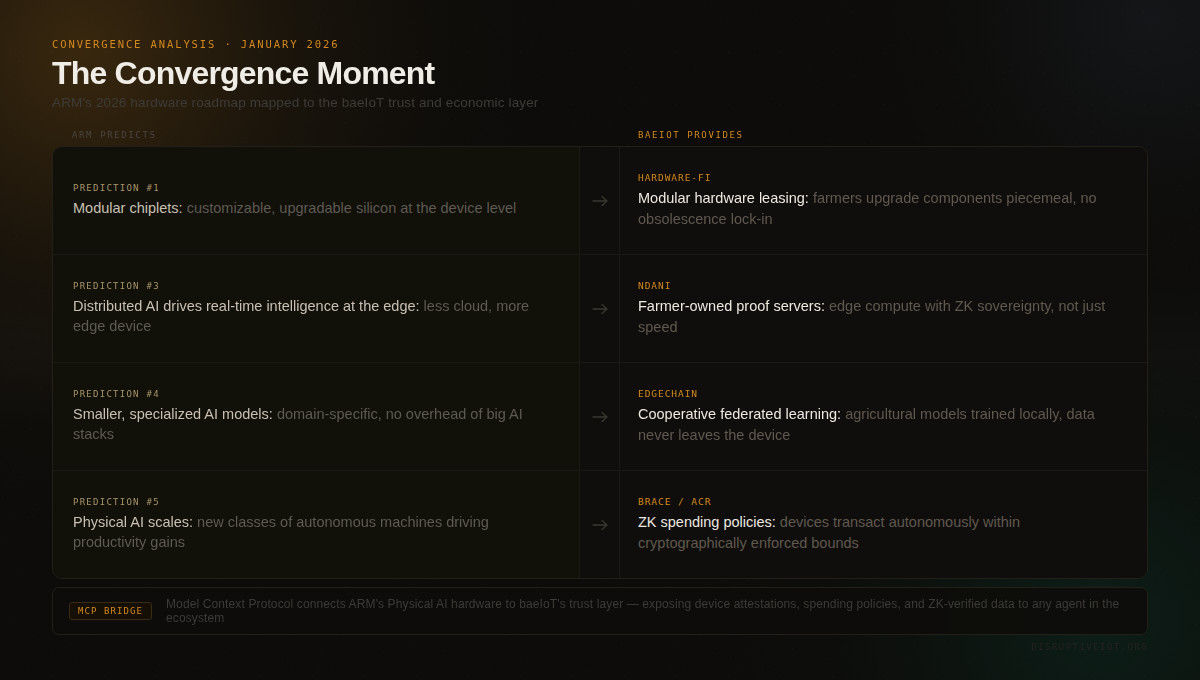
The silicon is ready. The models are shrinking. The edge is getting smarter.
The question is no longer "will devices become autonomous?" It's "who builds the infrastructure that makes device autonomy safe, verifiable, and economically viable?"
That's the question baeIoT answers. The industry is arriving at the same place.
What Comes Next
The agentic AI market is projected to reach $236 billion by 2034. Forty percent of enterprise applications will embed agentic capabilities by 2026. Physical AI is the next frontier. Edge intelligence is the architecture. Bounded autonomy is the trust layer.
We're not building for a future that might arrive. We're building for a future that ARM, NVIDIA, Deloitte, and Gartner all agree is already here.
The Internet of Things is becoming the Internet of Intelligence.
The question is: intelligence serving whom?
Solomon Kembo explores Physical AI/Edge AI infrastructure for the agentic economy. Follow the journey at disruptiveiot.org or connect on LinkedIn.
References:
- ARM, "2026 Tech Predictions," December 2025
- Gartner, "40% of enterprise applications will embed agentic AI by 2026"
- PYMNTS Intelligence, "The Two-Speed Enterprise Landscape," October 2025
- Anthropic/Linux Foundation, "Model Context Protocol achieves 97M+ monthly SDK downloads," November 2025